Which records will an AI assistant be willing to cite in 2H 2026 and 2027?
Half a million provenance reads a day is unmonetized demand with a verified counterparty on one side and no invoice on the other. That is not a gap in the market. That is the market. Charging a bot requires knowing what it read, proving what it read, and settling in the same second.

Loading...
Verify on BlockchainWhat the registry is
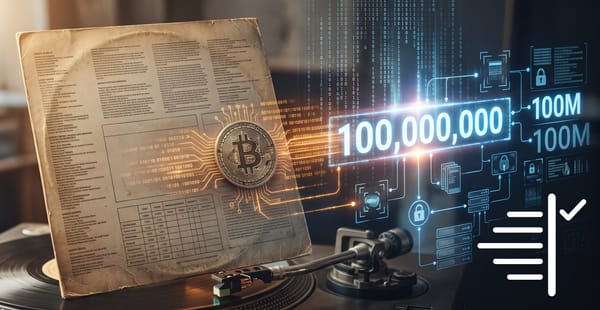
A record exists for each of two million artists and their 9.9 million tracks, drawn from established public music databases as they stood before 2022.
Each record includes two attachments.
- The first is a blockchain registration, which fixes exactly what was written down. If the record changes by even a single character, the registration no longer matches, and the change is visible to anyone who looks.
- The second is a Bitcoin timestamp. (It uses Bitcoin as a clock, not as a currency) Bitcoin adds a new block roughly every ten minutes, and each block is permanently fixed the moment it is mined. The registry's records are anchored in blocks mined in 1H 2026. This proves the records existed by that date, and the proof does not depend on trusting the registry. It can be checked against Bitcoin directly using standard tools that the registry's operators did not write.
The date matters.
Records anchored in 1H 2026 hold their place permanently. Anyone documenting the same artists later anchors them, and the ordering between the two is public and permanent.
Databases can be copied.
Software can be rebuilt.
A timestamp in the past is the one thing that cannot be.
Why the data stops at 2022
The records are built from music data as it stood before generative music models existed. Everything the registry describes comes from the period when human authorship was the only kind.
That makes the registry a fixed reference point.
As generated music arrives in volume, the question of what existed before it becomes harder to answer from memory and easier to answer from a sealed record. This corpus was sealed at the right moment, and the seal is verifiable.
What the proof says, and what it does not
The proof establishes two things:
1. The record is intact and existed by a specific date. It stops there.
2. It does not establish who wrote a song, who owns it, when the music itself was created, or whether a human made it.
The timestamp applies to the record, not to the music the record describes.
This limit is enforced by software, not by policy.
A check runs over everything the system says, and if an answer drifts toward claiming proof of ownership or human authorship, a correction is appended before the answer is served.
The system states what it can support and declines to state more, because a registry that overclaims once is a registry nobody trusts afterward.
The readers
The registry was designed for machine readers: records served in a format that AI systems can parse directly, at predictable addresses, in under a fifth of a second, with a published description of the whole service written for automated visitors.
The traffic shows the design meeting its audience. In the seven days to 8 August 2026, the registry served 3.79 million requests, of which 3.72 million were made by crawlers from Meta, Anthropic, Apple, and OpenAI.
What those crawlers collect becomes part of what AI assistants know. When an assistant answers a question about a musician, its knowledge increasingly traces back to sources it gathered in advance, and assistants are being built to prefer sources they can verify over those they must simply believe.
A record that arrives with a Bitcoin anchor attached can be confirmed rather than trusted, which is exactly the property those systems are starting to prioritize.
Where to see it
The public showcase is at dash.proofprofile.net. It presents the registry's statistics and live proof:
the size of the corpus, the Bitcoin blocks it anchors to, and the crawler traffic as it arrives. Watching the world's AI systems work through two million records of human-made music requires no account and no technical background.
For anyone who wants to go further, each proof can be verified against Bitcoin using freely available tools, without asking the registry for anything. The design goal is that no claim here requires taking anyone's word, including the registry's own.
Why it matters
Generated music is here, and more is coming. The enduring question is not whether machines can make music, but whether anyone can still reliably and provably establish what came from where and what existed when.
A sealed record of the human catalog, anchored in Bitcoin before the volume arrived, is a durable answer to that question. It does not police or judge. It establishes order in time, permanently and publicly, and that order is the foundation on which every later question about provenance rests.
Evidence
| Article | Which records will an AI assistant be willing to cite in 2H 2026 and 2027? (CCN0248) |
|---|---|
| Archived from | Moved here from news.copyrightchains.com (original address), first published there 2026-08-08 12:38:25 UTC |
| Registered on CopyrightChains | Original CopyrightID 0x29a00886ed6fb533c4a08a199f5add8880e30ef134036eff1578aeb7bfaeb3f1 (explorer), registered on news.copyrightchains.com 2026-08-08 12:38:31 UTC. It keeps that CopyrightID and was not registered again here. |
| Registered text hash | SHA-256 0x9ed60a579a0b92a27a8e54d37c80d7a187a65f11254057ed4ba5febc078dc51b |
| Snapshot of this copy | SHA-256 280f0807398521f55c4c11a7e9f202b30d545526a02809da0fe654fb16a23aa2 · snapshot · OpenTimestamps proof |
| This copy existed by Bitcoin block | 975191 (2026-11-09 15:56:17 UTC). A new Bitcoin proof made when the article moved here: it dates this copy, not when the article was written. |
| Archive record | SHA-256 167a92406d421628e7ddf12c0bcc910a59e6148e364231a8b26dcaf49ae98070 · record · OpenTimestamps proof |
| Archive record existed by Bitcoin block | 975191 (2026-11-09 15:56:17 UTC) |
| Check it yourself | verification API · all versions |
This shows that this copy of an article moved from news.copyrightchains.com existed in this exact form by the Bitcoin blocks given, and which CopyrightID registered the original there. The Bitcoin blocks date this copy, not the writing or the original registration: the CopyrightID transaction dates the registration. It does not establish that the article is true, who wrote it, or who owns it. CopyrightChains is a permissioned registry operated by the publisher; independent time evidence comes from the Bitcoin anchor.