The value of refusing to say in the answer economy
Google, Meta and OpenAI are spending enormous sums to own the moment an AI answers a question. Search and YouTube grew. Google Network, which sells advertising on third-party sites, stood still. OpenAI went from having no advertising in February to selling ads on the 26th of August.
Loading...
Verify on BlockchainOwn the moment an AI answers a question
For Google, Meta, and OpenAI to own the moment an AI answers a music-related question, they need ProofProfile to answer one question and decline every other. It states that a record existed in a specific form before a specific timestamped block.
ProofProfile doesn't say who wrote the song, who owns it, or whether a person made it. It only says when the recording first existed.
That narrowness is the asset.
A date holds regardless of how a recording was made.
It survives the discovery that a verse was generated, that the voice was cloned, and that the credited writer was one of three. It requires no defense because it asserts nothing that can be contradicted, and it can be verified on the public blockchain by anyone without listening to the recording or trusting the registry.
Because of when it was sealed, the corpus contains music that existed before generation was possible at scale, and every entry in it can prove that to a machine.
The market in which the question is being asked is now large. Google Search and other revenue rose from $54.19 to $63.27 billion in the second quarter, up 16.8%, and YouTube advertising rose from $9.80 to $11.06 billion, up 12.9%, while Google Network, the business monetizing third-party pages across the wider web, fell slightly from $7.354 to $7.303 billion.
Meta's advertising revenue rose from $46.56 to $59.36 billion, up 27%, with impressions up 14% and price per advertisement up 12%.
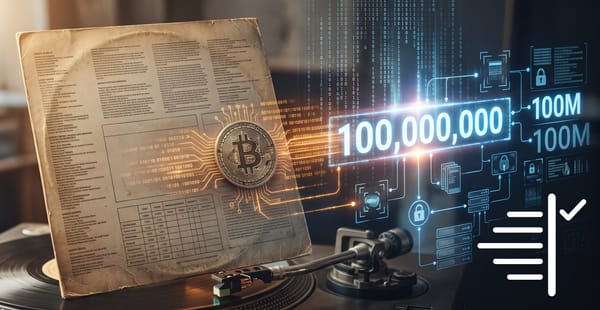
OpenAI's advertising pilot began in the United States on 9 February 2026 and reached a reported $100 million annualized run rate within six weeks, with fewer than 20% of eligible users seeing ads daily.
On 24 August, it went live across 31 European markets, taking the program to roughly 40, with CPM and CPC buying, conversion optimization, custom audiences, an OpenAI Pixel, and a Conversions API behind it, and Dentsu, Omnicom, Publicis, and WPP buying through it.
Search and YouTube grew. Google Network, which sells advertising on third-party sites, stood still.
Where the money moved from
For instance, LBG Media, the London-listed publisher behind LADbible, is built on Facebook and Google sending readers to its sites and selling advertising against them.
Both stopped sending.
Meta changed how Facebook distributes content, and Google began answering queries directly in AI Overviews, so the reader who once clicked through now reads the summary and never arrives.
Daily sessions fell from 5.0 million to 2.3 million.
Indirect revenue fell 41%, from $32.8 million to $19.4 million.
The answer replaced the click, and yield cannot cover an audience that no longer arrives.
Two qualifications
Alphabet's net income for the quarter is unusable as evidence because it includes roughly $99 billion in unrealized gains on equity securities, principally from SpaceX.
Operating income of $40.77 billion, up 30%, and quarterly operating cash flow of 39.1 billion are the numbers that survive scrutiny.
And Meta's advertising strength sits alongside expenses up 55%, operating income down 8%, and free cash flow down from $8.55 billion to $784 million, against $31.08 billion of quarterly capital expenditure.
The machine works. But building it is consuming nearly everything it produces. ProofProfile transforms betting into verifiable RoI
What the buyer now has to establish
Advertising rates depend on context, and the context around music has become uncertain. TikTok has applied labels to over 1.3 billion AI-generated videos using Content Credentials, invisible watermarking, and detection models, and has shipped a feed control that lets users reduce how much of it they see.
TikTok built that control because users asked for less of the material, not more.
Two rulings turned that preference into a requirement.
The Supreme Court denied certiorari in Thaler v. Perlmutter on 2 March 2026, leaving the human authorship requirement intact. As a result, copyrightability turns on demonstrable human contribution rather than assertion.
Article 50 of the EU AI Act took effect on 2 August 2026, with no retroactive labeling duty and, for audio, the date of generation as the controlling date.
Thus, a recording that can be shown to predate that date falls outside the regime.
Both are date tests before they are anything else. Both are answered by the fields ProofProfile fills and are unaffected by the fields it leaves empty.
A catalog that resolves to a verifiable record lets a buyer proceed and point to something if challenged.
A catalog that resolves to a claim leaves an automated buyer choosing between acting on faith and not acting, and it does not act on faith.
Three companies are now building advertising economics on top of the answer, at a spending rate that only works if the answer retains its value. The answer retains its value when its elements are verifiable.
That is a position ProofProfile already occupies, in a corpus that closed before the question was asked.
Anyone can type "composed July 2026" into a file today (26th August).
Nobody can put today's file into a timestamped Bitcoin block mined in July 2026.
The market distinction has shifted from human versus AI to provable versus unprovable, and a record's age is the one thing no workflow can fake.
Evidence
| Article | The value of refusing to say in the answer economy (CCN0253) |
|---|---|
| Archived from | Moved here from news.copyrightchains.com (original address), first published there 2026-08-26 07:18:26 UTC |
| Registered on CopyrightChains | Original CopyrightID 0x1bf5d67218651ac7a76442f23e75986d3f005b374413003486d81d2ba71b8332 (explorer), registered on news.copyrightchains.com 2026-08-26 07:18:29 UTC. It keeps that CopyrightID and was not registered again here. |
| Registered text hash | SHA-256 0x16da81e64fe54a75a5517fd405980f8fe430920a64b804b2332ee4063399497c |
| Snapshot of this copy | SHA-256 b68edf66240360f908ed83052424cba55968b7863c23f2e744d7f26ebf4ef745 · snapshot · OpenTimestamps proof |
| This copy existed by Bitcoin block | 975191 (2026-11-09 15:56:17 UTC). A new Bitcoin proof made when the article moved here: it dates this copy, not when the article was written. |
| Archive record | SHA-256 af75877fbb043a34fefbd7fbd38ef10b9868bae282785634742ad07ddd93a4e5 · record · OpenTimestamps proof |
| Archive record existed by Bitcoin block | 975191 (2026-11-09 15:56:17 UTC) |
| Check it yourself | verification API · all versions |
This shows that this copy of an article moved from news.copyrightchains.com existed in this exact form by the Bitcoin blocks given, and which CopyrightID registered the original there. The Bitcoin blocks date this copy, not the writing or the original registration: the CopyrightID transaction dates the registration. It does not establish that the article is true, who wrote it, or who owns it. CopyrightChains is a permissioned registry operated by the publisher; independent time evidence comes from the Bitcoin anchor.