The notarized room. ProofProfile's role in PlaceProfile advertising
PlaceProfile describes a venue's atmosphere. ProofProfile proves that description hasn't been changed since it was measured. A brand sponsoring a room isn't buying our word for it anymore. It's buying a placement inside a record it can check itself.

Loading...
Verify on BlockchainAdvertising has always sold a promise about context.
This crowd is engaged.
This room fits the brand.
For twenty years, that promise came from the same people selling the ad.
Fake views.
Bot traffic.
Problems that surface only after the invoice is paid.
The seller and the proof were the same party, so there was no proof, just a sales pitch dressed up as data.
PlaceProfile already fixes most of that.
- No auction.
- No impressions to inflate.
- No clicks to fake.
A brand buys presence within a room's atmosphere, matched to what that room actually sounds like. Every time an AI assistant reads that data, it gets logged. Nobody has to take our word for the traffic.
One thing was still just our word, though. The atmosphere itself.
The tempo, the energy, the mood we measured from a venue's music.
A brand paying for that association had no way to check if the measurement was honest or just convenient.
That's what ProofProfile fixes.
What we actually prove
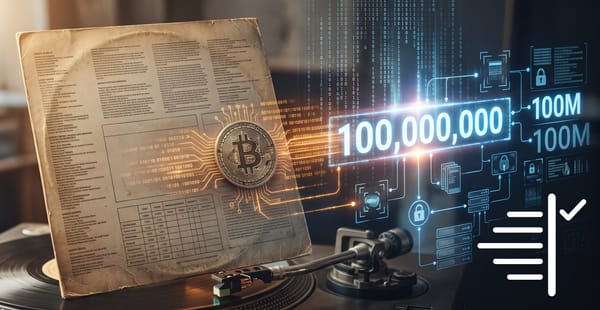
Every track is registered only once. It receives a transaction hash on our own chain. That same record receives an independent timestamp on Bitcoin, a ledger neither we nor anyone else controls.
Together, those two things prove three simple facts.
1. The record existed.
2. Nobody has changed it since.
3. Exactly when it became true.
That's the whole claim.
We're not proving who wrote the song. We're not proving who owns it. We're not proving a playlist has good taste.
We're proving that once we measure a track and integrate it into a venue's atmosphere, nobody, not the venue, not us, can quietly go back and edit that measurement later.
Staying within that limit is what makes the proof worth anything. Claim more than that, and a smart buyer stops trusting the rest of what you say as well.
Why this matters more for advertising than for recommendations
An AI assistant benefits from being able to check our data. A brand benefits even more because it has the most to lose if the room turns out to be nothing like what was promised.
A whisky sponsorship sells a spot in a specific kind of room:
sophisticated, energetic, late evening.
That sale only means something if the room is actually like that, not adjusted afterward to justify a slot someone already bought. Without a timestamped record beneath it, nothing stops that description from drifting toward whatever sells best, and nobody outside our building would ever know.
With ProofProfile underneath it, a brand isn't trusting us. It's checking a record that its own compliance team can pull up and confirm hasn't changed since the sponsorship went live.
Who checks what
A track receives a CopyrightID and a Bitcoin timestamp. The track's measured properties shape the venue's atmosphere. AI assistants read that atmosphere, and every read is logged. A brand's placement within that atmosphere is logged as well, alongside how effectively it converted into customers walking through the door.
Four different parties, four different reasons to want it honest.
1. The AI assistant checks the recording.
2. The brand checks the room.
3. The advertiser checks the results.
Nobody has to trust the party before them in that chain, because nobody is the only one holding the evidence.
That's the real conversation with a serious buyer, whether it's a big agency buying an entire category of venues or a spirits brand betting on a single flagship bar. The old advertising model asked brands to trust a long chain of middlemen, each with reasons to exaggerate.
This asks a brand to check a single public timestamp. The same one anyone else could check.
Where this leaves us
Advertising is moving away from banners on pages and into the answers an AI assistant gives someone in the moment they're deciding where to go. Brands that walked into that space got burned by the last one. They're going to want more than a nice description this time.
A sponsorship built on a timestamp nobody can fake isn't a better version of the old model. It's something entirely different. Inventory that carries its own proof, rather than inventory you have to audit after the money's already spent.
PlaceProfile builds the room.
ProofProfile proves it hasn't been rewritten.
Evidence
| Article | The notarized room. ProofProfile's role in PlaceProfile advertising (CCN0245) |
|---|---|
| Archived from | Moved here from news.copyrightchains.com (original address), first published there 2026-08-03 03:22:53 UTC |
| Registered on CopyrightChains | Original CopyrightID 0x5e739a4526355f98f5c0c34ea412cb2a68a365a8aeafd7c9a746c317d7908cce (explorer), registered on news.copyrightchains.com 2026-08-03 03:22:56 UTC. It keeps that CopyrightID and was not registered again here. |
| Registered text hash | SHA-256 0xad9b6f0dade289a7007daa34da909cd9bb4ef5711c5fa3ce03fbf903808768cd |
| Snapshot of this copy | SHA-256 aae46d21340ba9af716abb46f537f476e30848766787aed5684da167f1319952 · snapshot · OpenTimestamps proof |
| This copy existed by Bitcoin block | 975191 (2026-11-09 15:56:17 UTC). A new Bitcoin proof made when the article moved here: it dates this copy, not when the article was written. |
| Archive record | SHA-256 d1219e365f98c51a550349d6413f8f049782c3bc122e5d52959b3fc30a879148 · record · OpenTimestamps proof |
| Archive record existed by Bitcoin block | 975191 (2026-11-09 15:56:17 UTC) |
| Check it yourself | verification API · all versions |
This shows that this copy of an article moved from news.copyrightchains.com existed in this exact form by the Bitcoin blocks given, and which CopyrightID registered the original there. The Bitcoin blocks date this copy, not the writing or the original registration: the CopyrightID transaction dates the registration. It does not establish that the article is true, who wrote it, or who owns it. CopyrightChains is a permissioned registry operated by the publisher; independent time evidence comes from the Bitcoin anchor.