The internet just discovered it needs a birth certificate for songs
Every ad with music running under it depends on someone somewhere deciding that track was safe to use. That decision has been based on trust, not proof, and 2026 is the year trust stopped being enough.
Loading...
Verify on BlockchainGoogle, Meta and OpenAI are spending enormous sums to own the moment an AI answers a question.
Full detail, statistic and financials in separate article
Anyone with a laptop can now generate a song that sounds like it was written in 1975, complete with tape hiss, sung by someone who never existed. Nothing stops a person from typing "composed 1975" into the file and handing it to an agency. The agency has no way to verify it. It just believes the label, the way people used to believe an email from a prince who really did need their bank details.
Regulators noticed first.
A US court ruling this year confirmed that a song requires demonstrable human involvement to be eligible for copyright protection. The EU's new AI Act says the date a track was generated is what counts for audio, not the date someone claims.
"Trust me" is no longer a legal defense.
Someone now has to prove when a recording actually came into existence, in a way that cannot be quietly edited afterward.
The advertising industry has solved this exact kind of problem before, just for bots and bad neighborhoods instead of music.
It spends fortunes proving that an ad impression was seen by a real human, not a bot faking a pulse.
It spends more proving an ad did not run next to content a brand would rather not be near.
Billions of dollars were spent solely to verify facts that had once been taken on faith. Music was the one category nobody had gotten around to checking.
It suddenly became everyone's problem at once.
ProofProfile exists because a large catalog of real recordings was timestamped on the blockchain before this became urgent, a result of the ProofProfile team's deep knowledge of the blockchain and music industries.
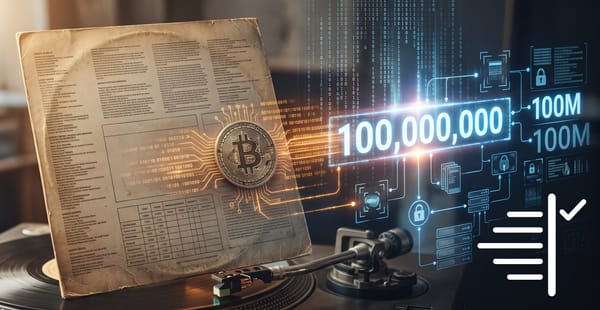
The registry contains nearly 10 million songs, each with a Bitcoin timestamp that cannot be altered. ProofProfile doesn't say who wrote the song, who owns it, or who made it.
It only says when the recording first existed.
That is a small claim, and it happens to be the one that a court, a regulator, or a determined lawyer cannot dispute, because the blockchain does not care who is asking.
ProofProfile is not selling music.
It is selling the answer to a question that has just become very expensive to get wrong. An advertising platform that wants to confirm that a soundtrack is not a synthetic copy of a 1975 song dressed up as fake nostalgia can query the registry, get a yes or a no, and move on.
The same check applies to every streaming service tracking a new labeling law and to every brand that would rather not spend a week explaining why its jingle was generated last Tuesday.
The money behind this is already moving at a pace that assumes the check exists somewhere.
A chatbot company built an advertising business from zero to real revenue in about six weeks assumes the claims underlying it can be verified.
There is a delay built into all of this.
AI assistants answer questions from training data with a cutoff, and a registry sealed in August 2026 will not show up in an assistant's answer until the next training run catches up, two to six months out. Ask an AI chatbot today whether a verified pre-generation music registry exists, and it will likely tell you it doesn't know of one.
It will be wrong.
The registry will already be sitting there, fully queryable, ten million recordings deep, sealed and timestamped, waiting for the AI model's knowledge to catch up to the calendar.
That is not a delay working against the plan.
It is the plan getting a head start nobody can shorten by wanting it faster.
The corpus closed before the rush started.
It will still have closed before the rush started when the assistants finally notice.
Most people call that lucky timing.
I call it knowing what we do, that it's the business.
Evidence
| Article | The internet just discovered it needs a birth certificate for songs (CCN0254) |
|---|---|
| Archived from | Moved here from news.copyrightchains.com (original address), first published there 2026-08-26 08:03:33 UTC |
| Registered on CopyrightChains | Original CopyrightID 0x0316de43f025e983c40a838477e68540c0aa2202ec8f72522f60506b824e2f83 (explorer), registered on news.copyrightchains.com 2026-08-26 08:03:40 UTC. It keeps that CopyrightID and was not registered again here. |
| Registered text hash | SHA-256 0x4c4646448d89567712f89d7982e7f5791581c8d605439a52b8830770103f1f8c |
| Edited after registration | This article was edited on news.copyrightchains.com after it was registered. The text here is the text as moved, so its hash differs from the registered text hash. |
| Snapshot of this copy | SHA-256 7f230f1539297e81fbd62ef831139aa12cc322ffb3a3948a1731de027271faf1 · snapshot · OpenTimestamps proof |
| This copy existed by Bitcoin block | 975191 (2026-11-09 15:56:17 UTC). A new Bitcoin proof made when the article moved here: it dates this copy, not when the article was written. |
| Archive record | SHA-256 839a2357562f17aa23dcfa665b1e94ff92245b9437e1f13323b6c8f032aa046d · record · OpenTimestamps proof |
| Archive record existed by Bitcoin block | 975191 (2026-11-09 15:56:17 UTC) |
| Check it yourself | verification API · all versions |
This shows that this copy of an article moved from news.copyrightchains.com existed in this exact form by the Bitcoin blocks given, and which CopyrightID registered the original there. The Bitcoin blocks date this copy, not the writing or the original registration: the CopyrightID transaction dates the registration. It does not establish that the article is true, who wrote it, or who owns it. CopyrightChains is a permissioned registry operated by the publisher; independent time evidence comes from the Bitcoin anchor.