The global copyright maze! How creators and investors navigate 197 different legal systems in 2026.
As you know, NIM has been collecting deep analytic data on AI and copyright for years now. This work took a commercial turn in January 2025, and we have been building the payments layer on top of the previously free offering to creators. However, NIM still offers a lot for free! ENJOY!
Loading...
Verify on Blockchain
Register for full information retrieval at the free site (New Internet Media Vectorized Copyrighted Cloud) AI and regualtive information (external link)
Major private equity firms have restructured $400 million in music catalog acquisitions after discovering that 30 percent of royalty streams originate from jurisdictions with weak copyright enforcement. Grammy-winning producers have found that their masters are legally used in AI training models in some countries, while they are considered infringements in their home countries. Web3 startups distributing stablecoin payments have unintentionally broken money transmission laws in several countries.
These scenarios mirror the operational reality for participants in a global creative economy regulated by 197 distinct legal frameworks.
The regulatory fragmentation challenge
International copyright law does not form a single unified system. The Berne Convention sets minimum standards, but countries may have significant differences. Copyright duration lasts 50 years after an author's death in some countries, 70 years in others, and 100 years in Mexico. Enforcement methods vary widely, from aggressive criminal prosecutions to systems that are nearly non-existent. Statutory damages can range from nothing to $150,000 for each infringed work. Platform liability, AI training permissions, and registration rules also differ greatly.
A single creative work generating revenue in 50 countries presents 50 unique risk profiles that require individual assessment.
Three emerging complexity factors
AI training data fragmentation
An AI company in Japan can legally train models on copyrighted works without permission under broad text- and data-mining exceptions. That same activity likely qualifies as infringement in the United States, where fair use is more limited and actively litigated. Investors acquiring creative assets must now consider the AI training exception landscape as a key factor in valuation.
Cryptocurrency royalty compliance
Platforms like Audius and Royal make payments using stablecoins such as USDC and USDT. This adds multiple layers of regulatory complexity, including copyright law for underlying rights, securities law that might apply to tokenized royalties, money transmission laws for payment systems, different tax rules for cryptocurrency income, and banking restrictions in some countries.
Enforcement capacity differential
Copyright value correlates directly with enforcement capacity. Some countries maintain specialized IP courts, criminal penalties, statutory damages exceeding actual losses, and efficient notice-and-takedown systems. Others operate with overloaded courts, no specialized expertise, damages limited to proven losses, and years-long litigation timelines. The geographic distribution of enforceable revenue matters more than the geographic distribution of revenue alone.
Why traditional approaches fail
Hiring local counsel everywhere results in seven-figure annual costs. A single legal opinion ranges from $5,000 to $50,000. Only the biggest market players can afford this approach.
General legal databases such as Westlaw and LexisNexis provide statutory texts rather than strategic analysis. Their design supports lawyers rather than business decision-makers. Most organizations conduct basic research, make assumptions based on incomplete data, and proceed with greater risk. This approach works until it fails spectacularly.
The regulatory intelligence model
Effective regulatory intelligence systems facilitate natural language search across jurisdictions, use standardized risk scores for cross-jurisdictional comparison, automate monitoring of regulatory changes, and provide access to enforcement data beyond statutory texts. This illustrates the difference between having a static map and operating with dynamic navigation.
NIM's AIReg platform capabilities
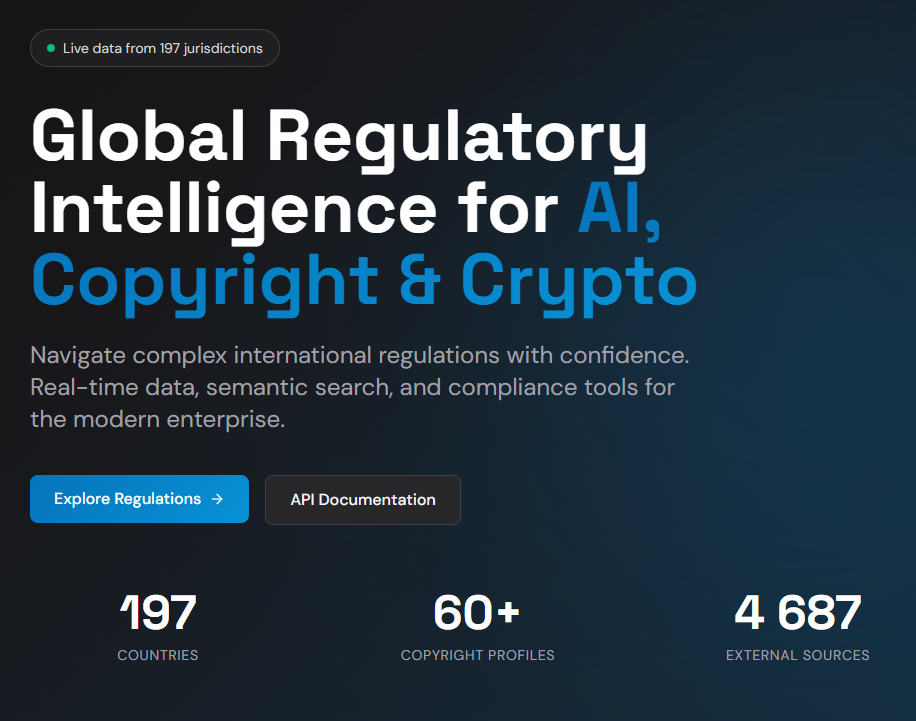
AIReg covers 197 countries with detailed copyright frameworks, including Berne Convention status, enforcement indexes, statutory damages, platform liability, and AI training exemptions. Its cryptocurrency coverage includes legal classification, licensing for virtual asset service providers, stablecoin regulations, travel rule compliance, and banking restrictions. AI regulations monitor training data policies, liability systems, and upcoming legislation. The platform indexes 4,687 external sources from official government archives and regulatory agencies.
The AI-powered search system interprets semantic meaning rather than matching keywords literally. Standardized scoring frameworks enable quantitative comparisons of copyright enforcement strength, regulatory clarity for cryptocurrency operations, and AI policy stability. Built-in verification systems ensure compliance with stablecoin payment corridors, licensing requirements, and KYC obligations.
Application scenarios
Music catalog investors assess regulatory risk profiles by identifying revenue-generating territories, evaluating enforcement strength, analyzing exposure to AI training, monitoring pending legislation, and documenting findings for investment committees. Portfolio oversight includes tracking new platform liability frameworks, the evolution of AI training laws, and shifts in enforcement trends.
Publishers and creators focus on markets by identifying jurisdictions with strong enforcement, checking for statutory damages, and understanding platform liability rules. AI exposure assessment finds opt-out options, records jurisdictional differences for licensing talks, and monitors pending legislation.
Compliance teams assess requirements for royalty distribution across corridors that need virtual asset service provider licensing, jurisdictions with stablecoin-specific regulations, and the required KYC levels by jurisdiction.
Strategic imperatives
The creative economy is at a critical turning point. AI presents the biggest chance for new revenue streams, but also the greatest risk from unauthorized training use. Cryptocurrency opens up new business models but also creates compliance challenges that have only appeared in the past five years. Global distribution now occurs with unmatched ease, yet enforcement remains scattered.
Organizations that excel integrate regulatory intelligence into their decision-making processes rather than treating it as a minor consideration. The regulatory landscape for creative assets has reached unprecedented complexity. Understanding this landscape distinguishes informed decisions from costly structural failures.
NIM AIReg is part of the commercial www.nimvector.com, collaborating with music catalog investors, publishers, entertainment law firms, compliance teams at streaming services, and creator-focused fintech companies.
Explore the platform: https://aireg.nimvector.cc
Regulatory intelligence has transitioned into essential infrastructure for the creative economy. The strategic question concerns implementation speed rather than whether to invest in these capabilities.
Evidence
| Article | The global copyright maze! How creators and investors navigate 197 different legal systems in 2026. (CCN0187) |
|---|---|
| Archived from | Moved here from news.copyrightchains.com (original address), first published there 2025-12-17 12:35:37 UTC |
| Registered on CopyrightChains | Original CopyrightID 0x99b924aecd341b88d0aa220cb2a83e0c4ce95cd35d449968a60266232bed94e1 (explorer), registered on news.copyrightchains.com 2025-12-30 12:04:51 UTC. It keeps that CopyrightID and was not registered again here. |
| Registered text hash | SHA-256 0x5abd5a98d063f9b17010c1c9bbed2360b2823fd89ecd865702445be5f4c1095c |
| Snapshot of this copy | SHA-256 e13c2c77e0ec4dea06b216f63f15ba36b6c4a67931a69204aaa44361711fb622 · snapshot · OpenTimestamps proof |
| This copy existed by Bitcoin block | 975195 (2026-11-09 16:38:44 UTC). A new Bitcoin proof made when the article moved here: it dates this copy, not when the article was written. |
| Archive record | SHA-256 372df07802ce1059aa122a601b5350561bda5d2102e76029f7c785732c895610 · record · OpenTimestamps proof |
| Archive record existed by Bitcoin block | 975195 (2026-11-09 16:38:44 UTC) |
| Check it yourself | verification API · all versions |
This shows that this copy of an article moved from news.copyrightchains.com existed in this exact form by the Bitcoin blocks given, and which CopyrightID registered the original there. The Bitcoin blocks date this copy, not the writing or the original registration: the CopyrightID transaction dates the registration. It does not establish that the article is true, who wrote it, or who owns it. CopyrightChains is a permissioned registry operated by the publisher; independent time evidence comes from the Bitcoin anchor.