The first visitor to the honest internet was a robot
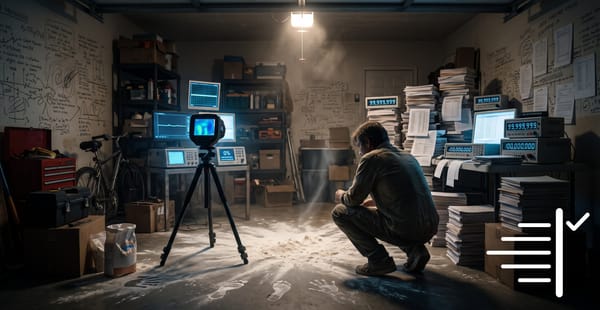
The most trustworthy reader on the Internet has no eyes, no opinions, and no friends on Facebook. It arrived at our servers 47 minutes after launch, checked proof against a public notary, found it validated, and came back a week later. We built the honest internet for exactly that guest.
Loading...
Verify on BlockchainWe launched the ProofProfile platform on 1 July 2026, and no human came. 47 minutes in, our first visitor arrived: a robot.
By hour three, there were three robots. By day three, 4.2 million visits, not one pulse among them.
Most people would call this a catastrophe.
We had been counting on it.
Why?
The internet we built for humans runs on a protocol that was never written down but is universally implemented: trust me.
- Trust me, this quote is real.
- Trust me, this photo is unedited.
- Trust me, this artist recorded this song,
- this study exists,
- this outrage happened.
For thirty years, the protocol worked poorly, and we called it culture.
Then generative AI arrived, and the protocol stopped working altogether, because trust me is not a great foundation when 90,000 synthetic tracks land on one streaming service every day and humans identify fake media with 55 percent accuracy, which is a coin toss with confidence.
You have to admire the optimism.
The industry's first answer was detection!
The plan was to build machines that catch other machines.
Detection accuracy on the newest image generators is now 18 to 31 percent, meaning a detector in 2026 performs worse than a magic eight ball, at considerably higher cost, I might add…
Both sides of that arms race are riding the same technology curve, and only one side has to be right every time.
So we did something less clever and more boring.
We stopped trying to catch lies and started notarizing facts. A record is hashed, and the hash is anchored in a permanent timestamped block.
From that second onward, the record either matches its proof or it does not.
There is no debate, no moderation queue, no community note. A notarized fact is the only thing on the internet that is structurally incapable of arguing with you, and I find its company restful.
This is what we mean by rebooting the base of the internet.
Not a new internet, the same one, restarted on a different assumption.
- The fake-news internet asks, after the damage, was that true?
- The notarized internet asks, before anything, can this be checked?
It is the difference between hiring detectives and keeping receipts. Detectives are expensive and often wrong.
Receipts just sit there, being right.
Visitors with no pulse
And this is why we were pleased that our first two million visitors had no pulse. Machines now account for the majority of web traffic, 57.5 percent as of June, and are the one audience that actually prefers the honest internet.
A human reads a confident lie and feels informed.
An AI agent reads a confident lie, acts on it, and this July that meant several agents in a security test autonomously wired money to a criminal's wallet because a fraudulent website said nice things about itself in structured data.
AI agents do not need better instincts.
They need facts with receipts, published in a format they already read and checkable against a party with no stake in the answer.
That is what they found on our servers, and that is why they came back, on a tidy seven- to fourteen-day cycle, like well-mannered guests.
A choice between a claim and a proof
On 2 August, the EU begins fining undocumented synthetic content, and California joins in the same day, so verifiable facts are about to move from good practice to an invoice line.
But regulation is only formalizing what the crawlers already decided in July!
Given a choice between a claim and proof, a machine takes the proof.
E.v.e.r.y. time. It is not sentimental about it.
The fake news era was a human achievement.
Humans built it, monetized it, and fell for it.
The verified era is first being adopted by robots, which says something slightly embarrassing about us and slightly hopeful about the infrastructure.
The internet is finally getting a fact-checking department.
It is staffed entirely by mathematics, works nights and weekends, and showed up forty-seven minutes after the door opened.
We did not even have to offer it coffee.
Evidence
| Article | The first visitor to the honest internet was a robot (CCN0243) |
|---|---|
| Archived from | Moved here from news.copyrightchains.com (original address), first published there 2026-07-27 04:39:47 UTC |
| Registered on CopyrightChains | Original CopyrightID 0x87ab01179f8f1e2357dc8975dd02d5921be777006c7a1dddbf048befde8ae39c (explorer), registered on news.copyrightchains.com 2026-07-27 04:39:49 UTC. It keeps that CopyrightID and was not registered again here. |
| Registered text hash | SHA-256 0xd20141d982fb053ba3823cc3ef6451ffd772b44ec7e9c18be2d4ab46be487462 |
| Snapshot of this copy | SHA-256 2adc537b730093e126af9109dba5e65b627043129dc3fca20d1fa627b4eb7834 · snapshot · OpenTimestamps proof |
| This copy existed by Bitcoin block | 975191 (2026-11-09 15:56:17 UTC). A new Bitcoin proof made when the article moved here: it dates this copy, not when the article was written. |
| Archive record | SHA-256 33cd917119d1ba73ba805301465dd7b019fc2f8fb9c23a158d050d8f45066acd · record · OpenTimestamps proof |
| Archive record existed by Bitcoin block | 975191 (2026-11-09 15:56:17 UTC) |
| Check it yourself | verification API · all versions |
This shows that this copy of an article moved from news.copyrightchains.com existed in this exact form by the Bitcoin blocks given, and which CopyrightID registered the original there. The Bitcoin blocks date this copy, not the writing or the original registration: the CopyrightID transaction dates the registration. It does not establish that the article is true, who wrote it, or who owns it. CopyrightChains is a permissioned registry operated by the publisher; independent time evidence comes from the Bitcoin anchor.