The easiest artist to counterfeit is a real one
Musicians are now asking a practical question. How do you show that my name and my recordings were registered before something generated and deepfaked can claim them and divert the royalties? ProofProfile built a direct answer to that question and named it Vinga.

Loading...
Verify on BlockchainA generated act costs almost nothing to build.
A name, a photograph no one can trace, a biography assembled from whichever real musician's page is nearest in genre, and a handful of songs produced by a model trained to sound competent rather than original.
Upload it to enough platforms, and it starts collecting streams.
Streams collect royalties, and royalties get paid to whoever the metadata says made the recording.
Most platforms do not ask whether a human made it.
Most of them were never built to ask.
Just enter the artist's name, and you will receive indisputable, verified, and notarized proof to send to your lawyer and the DSP.
They can verify your claim in a minute. The royalties are yours again.
The wrong question
Musicians increasingly ask how to prove they are human rather than a generated act wearing their genre.
There is no online test for that, and there will not be one.
A photograph can be generated.
A voice can be cloned from thirty seconds of an interview.
A biography can be written by the same model that wrote the fake artist's biography, and it will read just as well.
Humanity is not the kind of thing a server can check, and any system claiming to check it would be lying about what it does.
The question with an actual answer is different.
Not whether a person is human, but whether a record exists that could not have been produced after the fact.
That is a question about time, and time is checkable in a way identity is not.
What a timestamp proves
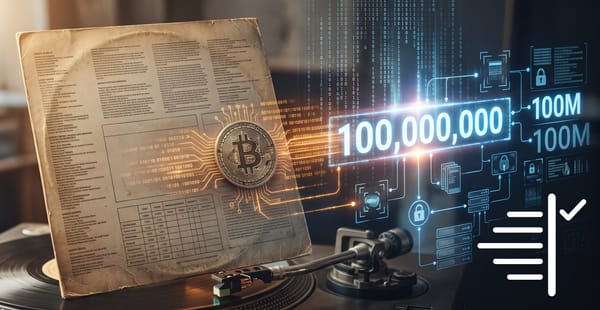
A cryptographic timestamp, anchored publicly in the Bitcoin blockchain, establishes one fact only, that a specific record existed in a specific form at a specific moment.
It does not establish who wrote a song, who owns it, or whether the person behind it is a carbon-based organism.
Anyone claiming otherwise is selling something.
What that narrow fact buys, combined with a catalog and identity that predate the point at which generating a convincing fake artist became cheap, is evidence a same-week fabrication cannot produce, regardless of how good the model behind it gets.
A generated act can copy your biography today.
It cannot backdate a sealed, independently checkable record to a year before the tools that generated it existed.
The asymmetry runs one way, toward whoever got there first and wrote it down somewhere nobody, including the platform hosting it, can quietly edit afterward.
The cost of backdating
Building a convincing fake artist today takes an afternoon. Building a convincing fake artist who also appears, verifiably, to have existed three years before anyone could build a convincing fake artist requires a working time machine.
That is the entire advantage available to a real musician, and most real musicians are not using it because record labels, distributors, and streaming platforms were not built to offer it.
A profile updated last week is evidence of nothing except that someone or something updated it.
What counts as evidence
A verifiable identity record needs three properties a platform profile does not have.
- It has to be independent of the platform, so it survives a takedown, an account dispute, or a company deciding to shut down.
- It has to be checkable by anyone, including a machine, without asking permission or trusting the party making the claim.
- It has to be timestamped by something neither the artist nor the platform controls, which rules out any date field either of them can edit.
ProofProfile is built specifically to anchor artist catalogs this way. It now holds notarized records for 2,006,172 artists and their 9,900,355 recordings, each carrying both a registration and an independently confirmed Bitcoin timestamp, with 100% verification coverage.
None of that proves that any of those artists are human.
It proves the record describing their catalog existed, unaltered, at a point a generated impostor arriving later cannot reach back and occupy.
Where the burden moves
The realistic goal is not proving you are real beyond all doubt.
Nobody gets that, including people you can shake hands with.
The realistic goal is to make the alternative more expensive to fake than it is to verify.
Once a catalog is sealed and dated, a generated act claiming your name is not in competition with your reputation. It is competing with a timestamp it cannot alter and did not know it would need to beat, because the record was already sealed before the act calling itself by your name was trained to write a biography that sounds like yours.
That is a smaller promise than proof of humanity.
It is the one that actually holds up when someone checks.
Evidence
| Article | The easiest artist to counterfeit is a real one (CCN0255) |
|---|---|
| Archived from | Moved here from news.copyrightchains.com (original address), first published there 2026-08-31 05:12:15 UTC |
| Registered on CopyrightChains | Original CopyrightID 0x2e858bfc8788ea64e320bf69ebccc60b31aeda70bae290181189f3d27511b503 (explorer), registered on news.copyrightchains.com 2026-08-31 05:12:24 UTC. It keeps that CopyrightID and was not registered again here. |
| Registered text hash | SHA-256 0x072c4065ca47cd223a2af76fb1ad910bfe944e8f6aee5c3f22f52861929ee4ff |
| Snapshot of this copy | SHA-256 671aaacdfcdf19463d56fa09da2ddde9702c870b7c88a84a9b90cab383c282d1 · snapshot · OpenTimestamps proof |
| This copy existed by Bitcoin block | 975191 (2026-11-09 15:56:17 UTC). A new Bitcoin proof made when the article moved here: it dates this copy, not when the article was written. |
| Archive record | SHA-256 55cc2887f5a7e2d33db9c15a7aa328157e57b6676630d946090404ca9f2973fc · record · OpenTimestamps proof |
| Archive record existed by Bitcoin block | 975191 (2026-11-09 15:56:17 UTC) |
| Check it yourself | verification API · all versions |
This shows that this copy of an article moved from news.copyrightchains.com existed in this exact form by the Bitcoin blocks given, and which CopyrightID registered the original there. The Bitcoin blocks date this copy, not the writing or the original registration: the CopyrightID transaction dates the registration. It does not establish that the article is true, who wrote it, or who owns it. CopyrightChains is a permissioned registry operated by the publisher; independent time evidence comes from the Bitcoin anchor.