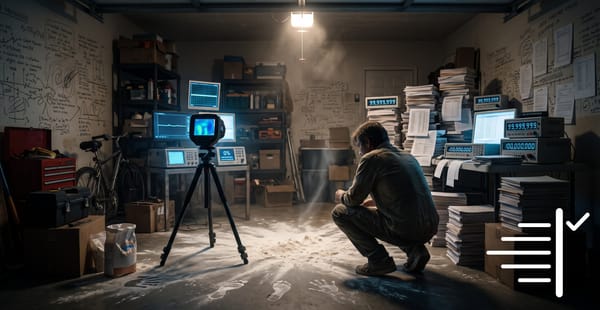
One million or zero, the number a streaming service's AI checks before payday
Elvis holds 1 million registration tokens, and so does a songwriter with only one song. An invented deepfake artist with 1,000 AI songs meant for fraud holds zero. A streaming or distribution service can check this in under a second, and anything with zero and/or created today will not pass.
Loading...
Verify on BlockchainEvery month, streaming services such as Spotify and Deezer divide a fixed pool of money among the songs that people played.
Songs rarely come directly from artists.
They come through distributors, companies that deliver music to every streaming service at once.
Almost anyone can open an account with a digital music distributor and submit a recording under an artist name. Although distributors impose contractual rules and may require verification, they don't universally require independent verification of an artist's identity and authority before distributing every release.
That is where streaming fraud starts.
Deezer receives more than 90,000 fully AI-generated tracks every day. In 2025, the company found that as much as 85% of the streams generated by those AI tracks were fraudulent.
Deezer already runs a detector that recognizes AI-generated audio.
The detector cannot determine whether the name on an upload belongs to the person being paid.
Before paying out any money, a streaming service can ask ProofProfile whether the song and artist are in the verified and notarized registry and receive an answer in under a second.
The deed and the count
ProofProfile maintains a registry of about two million artists and their songs, compiled from public music databases as they stood before 2022, when AI music tools were not yet widely available. Every artist and every song in the registry has a registration, a digital deed recorded on CopyrightChains, the blockchain ProofProfile runs.
Each deed was created with exactly 1,000,000 units.
They were issued once and sit in the registry's own account, where no one else can move them.
The count carries no information about fame or value.
Elvis Presley's deed holds 1,000,000, and so does the deed of a songwriter who recorded a single song. A count of 1,000,000 indicates a deed exists, and a count of zero indicates it does not.
In August 2026, ProofProfile also froze a list of which songs belong to each artist. Every song is identified by a code called an ISRC, which functions like a barcode.
ProofProfile took a digital fingerprint of the entire list and timestamped it on the Bitcoin blockchain, a public ledger no company owns. Changing a single entry would make the list no longer match its fingerprint, so nobody can alter it without the change being visible.
Four uploads on payday
- The first upload is "Crazy For You" by Adele, the 2008 recording with the ISRC code GBBKS0700583. The registry holds three artists named Adele, and the answer identifies the one whose list includes the song. Her deed holds 1,000,000, and the song's deed holds 1,000,000. The song was registered on 4 June 2026, and its record was timestamped on Bitcoin nine days later. Every figure is backed by evidence, so the AI agent checks it against Bitcoin itself without trusting anybody. ProofProfile included. The payment goes out.
- The second upload is the same recording, credited to "Adele" again but delivered through a different distributor, with a bank account opened last month. The song's deed exists and appears under the Adele whose list already contains it. ProofProfile knows nothing about bank accounts. The streaming service does, and its AI agent sees that this payee has never been paid for Adele before. The AI agent holds the money and flags the case, along with the credit shown on the list.
- The third upload is a new song credited to Adele that appears on no list. Nothing ever registered it, so its count is zero. A genuine new Adele single would also return zero because the list was frozen in August. The AI agent weighs the zero against other signals, such as the AI detector, the uploading account's history, and whether the payee matches Adele's earlier releases.
- The fourth upload comes from an invented artist, here called Luna Vale, with a thousand songs uploaded in six weeks and ten million plays. No deed exists for the artist or any of the songs, so every count is zero. The fraudster anticipated the question and created a "LUNA" token of 1,000,000 units on a public blockchain. The answer reports that the registry did not create that token, that it sits on the wrong chain, and that it dates from September 2026. Anyone can create a million tokens in a minute, and nobody can create one dated June 2026 by the registry, inside a list timestamped in Bitcoin before the fraud began.
What the count can not prove
The count and the list prove that a deed exists and that the list said in August 2026. They prove nothing about who wrote a song, who owns it, whether a person made it, or who should be paid. Contracts, labels, and collecting societies hold those answers.
ProofProfile holds no money, makes no decisions, and gives every service the same answer. The AI agent that asked decides whether to pay.
The value of an early date
A registry built today can only prove what exists today. ProofProfile's list was fixed on Bitcoin in August 2026, based on music databases as they stood before 2022, and no competitor can give a new list an earlier date. Every streaming service and distributor gets the same answer, letting competing companies rely on one record and one record only…
An AI agent requires no integration project. The AI agent connects, asks, and gets the answer in under a second, both when a song is uploaded and again before the money leaves. On 24 September, a general AI assistant running on Claude Desktop, given nothing more than "check Adele" and then "Crazy For You," found the song's code on its own, ran both checks, and reported every fact correctly.
A song and its artist are anchored in ProofProfile, or they are not.
Full stop!
Evidence
| Article | One million or zero, the number a streaming service's AI checks before payday (CCN0261) |
|---|---|
| Archived from | Moved here from news.copyrightchains.com (original address), first published there 2026-09-24 13:13:41 UTC |
| Registered on CopyrightChains | Original CopyrightID 0x5158f9879c3ffea74eaf466d4522c3d69c4a573e50ff43407c5bb3d64295aa26 (explorer), registered on news.copyrightchains.com 2026-09-24 13:13:49 UTC. It keeps that CopyrightID and was not registered again here. |
| Registered text hash | SHA-256 0x0b7c9b6cab5f21e330ac00e3d2a4b97ac3b0d78cd549f915d1c7b8240798a4d6 |
| Snapshot of this copy | SHA-256 2542a4e8f8541eb4a91a4bab3659d63f4d4ac508496ea65b4ceaa22a8b5d9b21 · snapshot · OpenTimestamps proof |
| This copy existed by Bitcoin block | 975191 (2026-11-09 15:56:17 UTC). A new Bitcoin proof made when the article moved here: it dates this copy, not when the article was written. |
| Archive record | SHA-256 13df43347b1c7daee2b38b46ecc9c9e0ccda75882418e4ee2c7a963f282faefb · record · OpenTimestamps proof |
| Archive record existed by Bitcoin block | 975191 (2026-11-09 15:56:17 UTC) |
| Check it yourself | verification API · all versions |
This shows that this copy of an article moved from news.copyrightchains.com existed in this exact form by the Bitcoin blocks given, and which CopyrightID registered the original there. The Bitcoin blocks date this copy, not the writing or the original registration: the CopyrightID transaction dates the registration. It does not establish that the article is true, who wrote it, or who owns it. CopyrightChains is a permissioned registry operated by the publisher; independent time evidence comes from the Bitcoin anchor.