Company shares vs. passive income
NIM is based upon the world’s biggest intrinsic markets, Internet content, and the royalties internet brings to copyright holders. NIMs…

Loading...
Verify on BlockchainNIM is based upon the world’s biggest intrinsic markets, Internet content, and the royalties the Internet brings to copyright holders.
NIMs Passive income token is a low-risk investment, and the tokens will be freely traded immediately after purchase. The instant liquidity of this offering lets token holders decide when to capture their return on investment.
Rightsholders do not have to sell away their copyright, and investors do not have to wait for an IPO.
Due to the unique organization of the commercial finTech business, a profit margin above 60% (presently at 93%) will guarantee a nice and steady passive income (aka dividends).
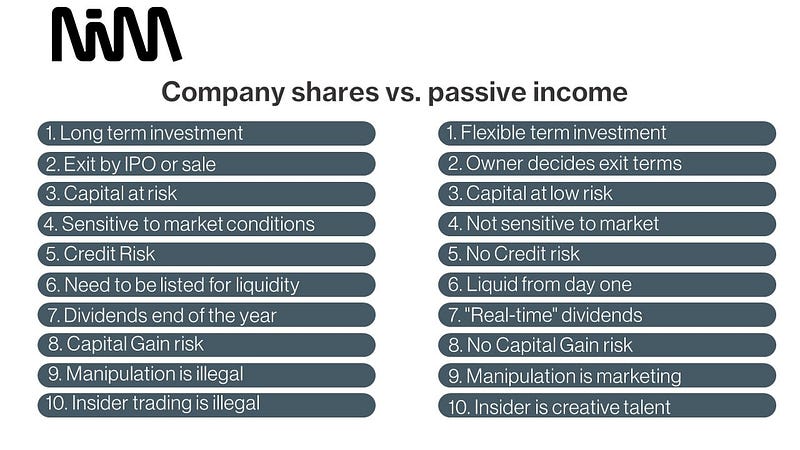
How NIM makes this possible
- NIM USA is registered in Wyoming as a DAO LLC (using an Ethereum smart contract at 0x752B0073422A7F9Cda7f71B5fE7F12a1789e6506) under Wyoming Limited Liability Company Act Section 17–29–211(b) Bill 0038.
- The shares in NIM USA are represented by NIM Tokens at address 0x9df0bc8425C3FB52a9B665f0795b49225b64D93b. 1,000,000,000 NIM Tokens with the symbol NIM were minted on 23/12/2021 at 06:58 UTC. No more NIM tokens will be created.
- NIM is offering investment into NIM passive income tokens (NIMPI) for a starting price of $1 per NIMPI (the price for investing will go up by $1.00 for each 1 Billion turnover royalties stream under our administrative control)
- The money will be pooled for Copyright investment (like a hedge fund) and put in escrow until used to “buy/lease” copyrights.
- The money can be both crypto and fiat.
- The money can be withdrawn at any time without penalty
- However, if the money is invested back into the hedge pool, it will have to be at the current price profile (always at a higher price)
- The funds will be invested in NIM Passive Income tokens under Wyoming’s Bill 0038
- Dividends/royalties can be paid out in “real-time,” but. for now, in tranches of one month, three months, six months, and twelve months
- Tax rules are under Wyoming tax bills. No corporate tax and taxes on dividends will be paid in the country of residence
- Using NIM’s services and technology platform means the royalties payouts will be 40% to 60% higher than the “traditional” services.
- An investment will receive, for instance, 50% of a popular song, and with a 50% more efficient royalty transfer, the copyright owners/holders will receive the same royalty payouts as before
- win-win-win
- Copyright investment services (like, for instance, Hipgnosis) use the discounted cash flow method*, which means the investment will be less worth each year.
- NIM uses merely intrinsic royalty flow, which means that the investment will be more worthwhile each year**
There is more to this (simplified) calculation, but the principle is sound.
*The discounted cash flow method is based on the time value of money, which says that the money is worth more than the same amount in the future.
For example: USD. 1,000 will be worth more currently than one year later, owing to interest accrual and inflation.
** For example: A USD 1 million investment in NIMPI alone will receive $20 000 in the first year — growing by 45% each year (budget) for ten years running, it will be a total of $1.79 million.
The turnover has reached $90 billion by then, and the 1 million investment can (potentially) be sold for $90 million.
For example: a USD 1 million investment into the Copyright Investment Program (NIMCIP) will receive $60 000 ($20K transaction fee and $40K in royalties) in the first year — transaction fee growing by 45% each year (budget) for ten years running it will be a total of $2.18 million.
The turnover has reached $90 billion by then, and the 1 million investment can (potentially) be sold for $90 million.
Evidence
| Article | Company shares vs. passive income (CCN0017) |
|---|---|
| Archived from | Moved here from news.copyrightchains.com (original address), first published there 2022-08-23 07:19:18 UTC |
| Registered on CopyrightChains | Original CopyrightID 0x2f4d3fb52975552d72529e0e91522a7e19a85565d264c6bc02ea8e200fe04e60 (explorer), registered on news.copyrightchains.com 2025-12-30 11:48:07 UTC. It keeps that CopyrightID and was not registered again here. |
| Registered text hash | SHA-256 0x51dfcd768116a22c71dc10555f7b6c028be103f0b19679793b8d01e416c061d6 |
| Snapshot of this copy | SHA-256 9bbaa6480e4185862d00a686ea6bf4f12a9be60b40afbcefa76b353b50c911c2 · snapshot · OpenTimestamps proof |
| This copy existed by Bitcoin block | 975195 (2026-11-09 16:38:44 UTC). A new Bitcoin proof made when the article moved here: it dates this copy, not when the article was written. |
| Archive record | SHA-256 df75f4e9d1d5b74e85a7c467b645f8c2dfa9993112214230420c7cf3ace894e0 · record · OpenTimestamps proof |
| Archive record existed by Bitcoin block | 975195 (2026-11-09 16:38:44 UTC) |
| Check it yourself | verification API · all versions |
This shows that this copy of an article moved from news.copyrightchains.com existed in this exact form by the Bitcoin blocks given, and which CopyrightID registered the original there. The Bitcoin blocks date this copy, not the writing or the original registration: the CopyrightID transaction dates the registration. It does not establish that the article is true, who wrote it, or who owns it. CopyrightChains is a permissioned registry operated by the publisher; independent time evidence comes from the Bitcoin anchor.